
Authentic Progress
Change-maker leaders commit to cultivating a world of Authentic Progress where each of us ignites change, economies serve all, and potential knows no bounds.
Together we participate in and build a Sacred Canopy of Care for each other and all the rich diversity of Earth.
Below are some of the books that brilliantly describe the key elements of this work, signposts to services and communities that do the hard work of transition, and click here for our blog.


Signposts
Services and communities that do the hard work of transition. Check them out and get involved!

The Human Centre
Andrew Drummond
While many initiatives frame human-centricity as a moral imperative, The Human Centre frames it as a hard business strategy. Founded by Andrew Drummond, the organization leverages empirical data - specifically research from EY and Said Business School - indicating that human-centered transformation projects are 2.6 times more likely to succeed than those that prioritize process over people.

1% For The Planet
Kate Williams
Founded by Yvon Chouinard (Patagonia) and Craig Mathews, 1% for the Planet establishes a simple but rigorous commitment: business members donate 1% of gross sales (not profit) to vetted environmental nonprofits. This distinction is critical; it ensures accountability regardless of the company's profitability, framing the donation as a cost of doing business - essentially "rent" for the use of the planet's resources.
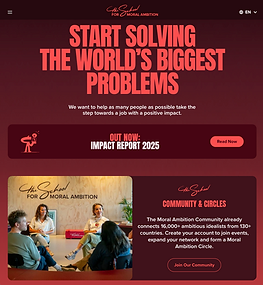
The School for Moral Ambition
Rutger Bregman
This initiative functions as a recruitment and advocacy platform, encouraging individuals to direct their ambition toward "moral" ends - careers that address climate change, pandemics, and poverty. It provides the philosophical "why" for Change-Makers, framing the transition to impact not as a sacrifice of ambition, but as an upgrade in ambition.

Intrapreneur Action Fellowship
Jolana Jamuna Amara
The League provides a "Global Theory of Change" and specific infrastructure like the "Action Fellowship," which focuses on the intersection of climate, technology, and equity. This 9-month journey (Kick-off, Immersive Gathering in Greece, Global Celebration in Brazil) connects isolated innovators, providing them with the "tribe" necessary to survive internal politics. By validating their role and providing mentorship (from over 20+ mentors), the League turns lonely struggle into collective momentum, effectively planting "Trojan Horses" of sustainability inside Fortune 500 companies.

Pledge 1%
Amy Lesnick
This structure creates a "force multiplier": as the company grows, the value of the 1% grows exponentially without requiring cash flow in the early stages. Over 19,000 companies in 130 countries have joined, unlocking billions in new philanthropy. It transforms social responsibility from a "nice-to-have" into a binding, scalable asset class.

The Conduit
Paul van Zyl
The Conduit, located in Covent Garden, London, was co-founded by Paul van Zyl (a human rights lawyer) and Nick Hamilton to solve the "conference hangover"—the dissipation of energy that follows global summits. It provides a permanent physical and intellectual home for a community of entrepreneurs, investors, and activists.

The Purpose-Led School
Louise Le Gat
The Purpose-Led School, founded by Louise Le Gat, articulates a theory of transition that distinguishes between the "Old Game" of business - defined by extraction and linear growth - and the "New Game" of regeneration. Le Gat posits that many leaders suffer from an "invisibility trap," dimming their unique insights to fit into obsolete structures. The initiative’s core mechanism is the transformation of the leader from a "Good Soldier" (who maintains the status quo) to a "Brave Builder" (who actively constructs the future).

Blue Earth Summit
Will Hayler
The Blue Earth Summit disrupts the sterile aesthetics of the traditional business conference. Inspired by the Great Outdoors and surf culture, it connects founders, investors, and adventurers in a "festival" atmosphere (often held in Bristol and London). The core premise is that connection to nature fosters better business decisions.

The BMW Foundation Responsible Leaders Network
The Foundation manages the "Responsible Leaders Network," a highly curated global community of over 1,000 leaders. Through "impact circles," "accelerator programs" (like RESPOND for clean-tech and urban-tech), and high-level forums (e.g., The Leaders Collaboration Forum), they facilitate cross-sector dialogue that might not otherwise occur. For a Change-Maker, this network provides high-level legitimacy and access to capital and policy influence, validating their work on an international stage.


First Human
Richard Atherton and Oddi Aasheim
FirstHuman differentiates itself by rejecting the "fluff" often associated with leadership development. Their philosophy, driven by partners like Richard Atherton and Oddi Aasheim, asserts that "leadership is downstream of physiology" and identity. They argue that breakthroughs - results that exceed predictable improvements - are blocked not by a lack of strategy, but by the leader's "internal monologue" and "rackets" (fixed complaints or defensive behaviors).

Meaningful Business
Tom Lytton-Dickie
The platform facilitates rapid, borderless connections (e.g., connecting a founder in London with a peer in Nairobi). It offers mentorship programs and workshops that help leaders scale their impact. For the Change-Maker, it provides global reach and validates the work of those doing the "heavy lifting" of impact on the ground, often away from the limelight.


Letters to The Earth
Kay Michael
Letters to the Earth is a creative campaign co-founded by Kay Michael and others in response to the climate emergency. It invites the public (including artists, children, and indigenous leaders) to write letters to or from the Earth, future generations, or species facing extinction. This initiative provides the "emotional infrastructure" for the movement. By utilizing the arts to process eco-anxiety and grief, it democratizes the climate conversation. Change-Makers can use this tool to engage hearts, not just minds, fostering deep cultural change within organizations by inviting vulnerability and authentic expression.

The B Lab Movement
Chris Turner (UK)
B Lab is the architect behind the B Corp Certification, widely regarded as the most rigorous standard for social and environmental performance. Its "Theory of Change" seeks to transform the global economy from shareholder primacy to stakeholder governance. Companies must amend their legal governing documents to require the board of directors to balance profit and purpose.

The Bio Leadership Fellowship
Andres Roberts
The Bio-Leadership Fellowship, co-founded by Andres Roberts, represents the frontier of regenerative leadership. It operates on the philosophy of biomimicry applied to organizational design. The initiative views the current polycrisis as a symptom of humanity’s "separation from life" and seeks to build a "human mycelium" - a distributed, resilient network of leaders working with the principles of nature (circularity, interconnection, regeneration).

Craigberoch
Gib Bulloch
In a business culture obsessed with speed and acceleration, Craigberoch offers a radical counter-proposition: "deceleration." Founded by Gib Bulloch, a pioneer of intrapreneurship at Accenture, the initiative is based on the Isle of Bute, Scotland. Bulloch’s thesis is that innovation does not happen in the "red zone" of stress; it emerges from the "white space" created by slowing down.